Maimouna Doumbia - Rubin Museum Paper
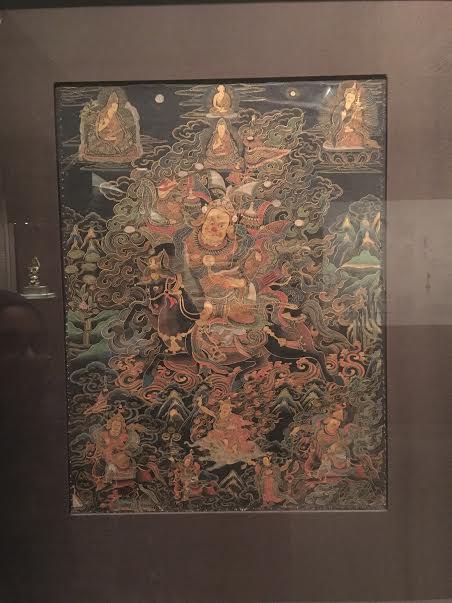
Tsangpa Karpo
Buddhism - The Religion of Finding Ones True Self
Since the ancient world religion had always impacted and played a very important role in many civilizations. In the region of India the religions of Buddhism and Hinduism provided a cultural system of worship for individuals that helped set forth a path that they can take in order to achieve some form of salvation. Looking at the interesting painting of Tsangpa Karpo we can see the representation of The Four Noble truth in Buddhism. When looking at the two major religions of India it can be notice that they are both very parallel to each other. The Four Noble Truth in Buddhism is similar to Atman In Hinduism because they both speak about understanding the nature of desire. Although in Hinduism Atman is known as the understanding of one's true self that help end the cycle of reincarnation, while in Buddhism the Four Noble Truth is the key for one to become an enlightened being. Through meditation one can acquire qualities that can help them gain enlightenment of the self in Buddhism. Once this enlightenment is reached it help end their life of suffering. Looking at artwork and religious doctrine it helped in my understanding of the religion Buddhism.
The artwork of Tsangpa Karpo is a very interesting work of art. What attracted me to the painting is the different buddhas that are surrounding Tsangpa Karpo in the artwork. This caught my interest because I wanted to understand why the Tsangpa Karpo was the focal point of the painting. Looking at a huge figure of the angry looking tsangpa Karpo with weapons in his hands spark my interest and made me wonder what can be the cause of his rage. I wanted to understand the deeper meaning of the painting and understand why the buddhas were smaller in size and not at the focal point of the painting.
The painting of Tsangpa Karpo was painted in Tibet during the 17th century by an anonymous tibetan. The rough dark colored cotton cloth with pigments depicts a large sized figure of Tsangpa Karpo outlined in gold in the center dressed in a warrior like costume sitting on top of what seems to be a flying brown horse. By the looks of his face Tsangpa Karpo looks very evil. On his head he has a crown that is filled with shells and a feather. In his right hand Tsangpa Karpo was holding upwards a curved sword and in his left hand he is holding onto an object that resemble a string. Surrounding Tsangpa Karpo are thin lines that form into swirls that looks like clouds and smoke. At the corner of each painting there are geometric shapes of triangles that resemble the moon. At the top of the painting there are smaller sized figures of humans sitting in meditation style on top of a cloud with their right hand in a teaching gesture. Each figure representing a different type of buddha. A little above the smaller figures are a geometric shape of circles one representing a moon and the other a sun. At the bottom of the painting there are smaller sized figures that look just like the Tsangpa Karpo at the center of the painting. They look like they are assisting the Tsangpa Karpo since they look like they represent the same thing that he is representing. The only difference is that each of the figures on the bottom of the painting are seated on a different type of animal.
The Tsangpa Karpo is known as a wrathful deity in the religion of buddhism. This goes to explain why he has a look of a very evil person and the weapons that he carry in his hand. He is the biggest figure at the center because he is a protector and his duty is to protect all the smaller buddhas that are surrounding him. When looking at the Tsangpa Karpo image in the painting it can be mistaken that he only represents evil. But the reality is that his looks are deceiving and he only look that way in order to scare off all the obstacles that are in the way of those that surround him. According to Barbe, “The wrathful deities often adopt the forms, which they seek to destroy in us. They exaggerate these images in order to thieve our attention away from the deadly distraction of evil in the world, draw us into an awareness of these evils so that we may transcend them” (Barbe). Basically, Tsangpa Karpo exaggerated image is only a way to try and put a control on all the obstacle that is causing the problem of the buddhas. An example of this is can be seen in a mother who is trying to protect her children. When a mother feels something might put her children into harm she then puts on a fearful image out of love so that she may protect her children. Similarly in the painting the enlightened Tsangpa Karpo have a wrathful look so that he just like a mother can protect the buddhas.
The painting of Tsangpa Karpo illuminates the philosophical doctrine of the Four Noble Truth. In the doctrine of the Four Noble Truth it speaks about the first noble truth which is suffering or dukkha. In the doctrine it explains, “It is because one does not accept impermanence, and constantly seeks and desires that things be permanent - youth, healthiness, loved ones, treasured possessions, and so on - that one fuels the continuity of unsatisfactoriness, as one's very desires are somas to to disappointment”(Hamilton 47). What this means is that one needs to have a realization that the suffering in life is caused by us clinging to everything that is not permanent. And when we do that we put our trust into that which will endangering our own happiness because it is bound to end. I relate this doctrine to the painting of Tsangpa Karpo because of his duty. It is known that humankind will make mistake so he as the worldly helper makes people see past their desires so that they don't cling onto it and are able to reach their enlightenment.
In both Hinduism and Buddhism the goal is for one to be enlightened and be freed from the impermanence of this world. In Hinduism when one reaches enlightenment it is known as being in the state of moksha. In order for one to reach moksha they must gain atman which is the understanding of the true self. For one to understand the true self they must free themselves from the trouble desires that this world brings. Similarly, in Buddhism for one to become enlightened or reach nirvana they must understand the Four Noble Truth. The four noble truth is in a way a guide that will help one understand dukkha so that they can understand the relationship that suffering have with the desire. When this is happened one is able to reach nirvana a state in which they are enlightened. In both religions for one to understanding of the true self or what is consider truth is what brings one to enlightenment. The only difference in both religions is the way enlightenment is reached. In Hinduism enlightenment can be reached through the understanding of one's true self while in Buddhism one reaches enlightenment by having a balance in life.
Buddhism is a way of life and its people are followers of the teachings of the buddha. Even though an afterlife and a supernatural being is not mentioned in buddhism like in all other beliefs it can still be seen as a religion. This is because there is a cultural system of worship in place where its followers are trying to attain enlightenment in the form of meditation. Buddha did not have any concerns of a God and he did not consider himself as one. His only goal was to get the human being to escape suffering and to teach that knowledge to those that come after him so that they too may be enlightened. Even when watching the PBS documentary on Buddhism it states that buddha means the awakened one and anyone is able to become a buddha. All they have to do was follow in the footsteps of the buddha with the full control of their own soul.
Throughout this experiment I learned allot about Buddhism and that was just from looking at different artwork and understanding the deeper meanings behind them. This helped me better understand buddhism because I was able to see the religion from the points of paintings and cultures which made me question allot of things that were being depicted. It was a very interesting experience and it taught me allot about Buddhism.
Work Cited
Barbre, Claude. "ART." Journal of Religion & Health, vol. 45, no. 3, Fall 2006, pp. 467-468. EBSCOhost, doi:10.1007/s10943-006-9043-8.
Hamilton, Sue. Indian Philosophy: A Very Short Introduction. Delhi: OUP India, 2006. Print.


Foremost, your paper was very well written! I can see how Buddhism could be classified as a religion, as I made the same claim in my paper, however as this class progressed I feel like it’s possible to refute that claim. For example, you noted how Buddha never concerned himself with a god/gods or the afterlife, and said "...it can still be seen as a religion. This is because there is a cultural system of worship in place where its followers are trying to attain enlightenment in the form of meditation.” While it’s true that most religions do have a community that encourage one another through spiritual and healing practices, in this case meditation, I don’t think that automatically puts Buddhism in the same category. I think Buddhism is more related to philosophy than religion as we know it, because most religions do revolve around belief in an afterlife, a reason or explanation for the creation of the universe, and punishment or reward depending on the actions of the follower, (i.e. reincarnation as a lower or higher member of a caste system in Hinduism and heaven/hell in Abrahamic religions). While other religions, especially Abrahamic, require its followers to acknowledge a higher being, whether it be God, gods, or an all supreme being, Buddhism doesn’t attract followers based on fear of the afterlife and the possibility of feeling the wrath of God. I feel like Buddhism is a system to follow in order to gain inner peace within ourselves. Buddhists seek guidance from Buddhism as a way to cope with the questions in life that are just unanswerable. This is similar to philosophy. There are certainly groups of philosophers that act as a community to understand life, our purpose, and various other aspects of each, but I wouldn’t call that a religion either. Siddhartha Gautama developed The Four Noble Truths and The Eightfold Path as a way to control desire and dissatisfaction. He was able to provide this guidance to others after suffering from questioning the purpose of desire and dissatisfaction that lead to despair in our lives, and similarly, philosophers are always asking questions and discussing ideas with other people seeking similar rationalizations.
ReplyDeleteHello Katherine,
ReplyDeleteThank you for the comment.
I can totally agree with what you are saying in the comment above. As the class progress I did begin to question my own reasons as to why I believed buddhism is a religion. I never seen it in the perspective of it being a system of orders in which one follows in order gain inner peace with the concerns they have in life that are not simple to answer. But the thing that still make me hold on to my belief that Buddhism is a religion even though it differ from the Abrahamic religion which believe in an afterlife and in Superhuman form such as God, is that it is a way of living just like most other religions in order to destroy the things that is in us and stopping us from being the best people possible. Unlike most religions it never got to explaining a divine and I believe the reason for this can be explained from how the religion began. Because it is a religion started by a man looking for enlightenment in life once he found that enlightenment his purpose of life was fulfilled. When we look how the Abrahamic religions began we tend to see that God send a man known to be a prophets to send his message on this world and the afterlife. Unlike buddhism which is only trying to get the fulfillment of this life Abrahamic religions believe ones cycle isn't complete until the afterlife where they will be reunited with God. So to conclude I believe that Buddhism is a religion. Since it was not something that started with a God it is impossible for us it to end with one. That does not take away from the purpose of buddhism which is solely focused on fulfilling enlightenment in this world alone.
How has learning about the complexities of doctrines and philosophical debates from global religions helped you gain a sense of self-awareness within both local and global contexts?
ReplyDeleteOne thing that I learned from both the doctrines and the philosophical debates where that each had its own strengths and weaknesses. From the doctrines I learned more of the historical aspect and facts on how the religion began and what the main focus in the religion where. Although this gave me an in-depth background of the religion it was not enough to see the bigger picture. But, once we got into debate mode in class we began to digest the information we got from the doctrine to better understand the true meaning of the religion. Similarly the debates would have been useless if we were only speaking from our opinion with no facts which serve as a foundation for the discussion. All in all, both the doctrine and the discussion go hand in hand because they both come from different focal points to better understand one thing. What I learned was we need to consider the facts of doctrines and understand them but also have our own opinion to what we have learned.